
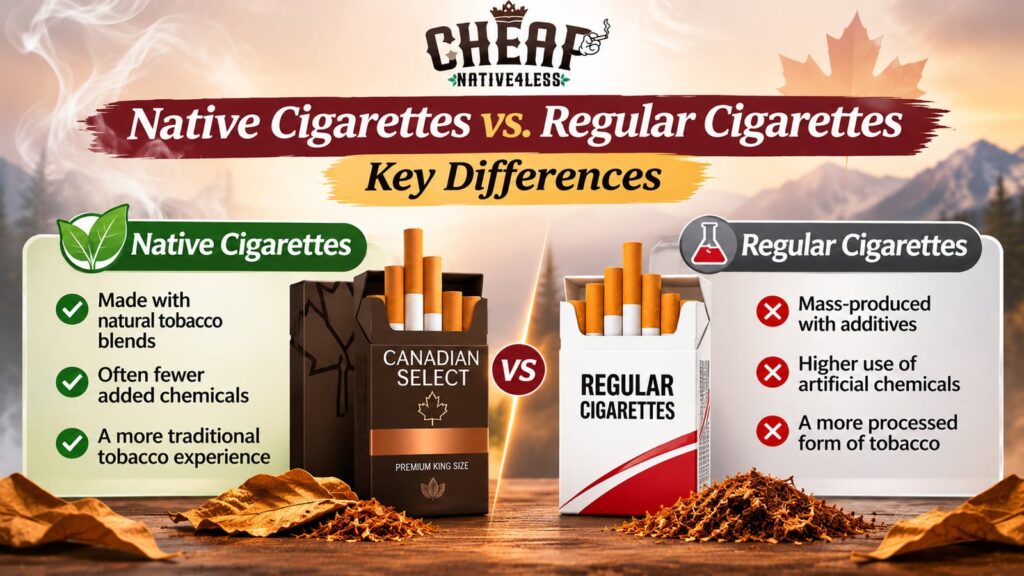
Stand two packs side by side and, at first glance, you might struggle to tell them apart. Plain brown packaging, a health warning, a slide-and-shell design: the federal rules make most cigarette packs look alike. Yet the story behind each pack can be very different, which is why so many adults ask how native cigarettes vs. regular cigarettes actually compare.
The answer has less to do with how a cigarette smokes and more to do with who makes it, how it reaches you and how tax shapes the price. This article lays out the differences clearly, and just as importantly, the things that do not change at all.
Who Makes Them: The Starting Point of Every Difference
Regular cigarettes, often called commercial or mainstream cigarettes, come from large tobacco manufacturers that distribute through national networks of supermarkets, convenience stores and gas stations. Their brands are the ones most Canadians recognise from behind a store counter.
Native cigarettes are made by First Nations–owned businesses, usually on First Nations territory, and sold under their own brand names. The tobacco is blended, rolled and packed much as it would be elsewhere. The meaningful difference lies in ownership, location and the channels the product travels through.
Where You Buy Them
The shopping experience is the next noticeable contrast.
- Regular cigarettes are sold at licensed retail counters, and the packs are kept out of customer view, as display rules require.
- Native cigarettes are sold at on-territory shops and through Indigenous-owned online retailers that ship to adult customers after an age check.
Because of that, buying a native brand often involves a little more reading and a little more planning. You may be browsing a product page, comparing carton options and checking delivery details rather than asking for a pack across a counter.
How Tax Shapes the Price
Price is where most people feel the difference, and tax is the reason behind it. A cigarette’s final price is built from several layers: the manufacturer’s price, federal excise duty, provincial tobacco tax and sales tax. For mainstream products sold through ordinary retail, all of those layers are typically included in the shelf price.
For native cigarettes, the way tax applies depends on the product, the sale and the buyer. Provincial rules recognise specific tax treatment for First Nations individuals buying products for their own use on reserve, for example.
That structure is one of the main reasons shelf prices for the two categories can sit far apart. It is also why a careful buyer reads the shipping and legal information for their own destination before ordering.
Native Cigarettes vs. Regular Cigarettes at a Glance
| Factor | Regular (commercial) cigarettes | Native cigarettes |
|---|---|---|
| Maker | Large national tobacco manufacturers | First Nations–owned businesses |
| Typical brands | Nationally advertised household names | Brands such as DKS, Canadian Classics and Canadian Lights |
| Where sold | Supermarkets, convenience stores, gas stations | On-territory shops and Indigenous-owned online retailers |
| Tax treatment | Duty and tax built into the shelf price | Depends on the product, the sale and the buyer |
| Packaging rules | Plain, standardized, slide-and-shell packs | Same federal framework for retail sale |
| Health warnings | Required on every pack | Required on every pack |
| Minimum pack count | 20 cigarettes | 20 cigarettes |
| Age to buy | Minimum legal age in your province or territory | Minimum legal age in your province or territory |
Questions Worth Asking Before You Choose
Instead of asking which category is “better,” it is more useful to ask which one fits your situation. A few prompts can help:
- Is price the main priority? If so, compare the price per cigarette across several carton sizes, not just the headline pack price.
- Do you value a particular brand or strength? Check that the style you like is actually offered before you commit to a carton.
- Does it matter to you who owns the business? Some buyers prefer to support Indigenous-owned retailers, and that is a perfectly valid factor.
- Are you comfortable with the buying process? Online orders involve age verification, delivery tracking and a little extra reading, which suits some shoppers better than others.
- Have you checked the rules for your destination? Provincial requirements differ, so a quick review beforehand keeps the process smooth.
Conclusion
When you strip away the marketing language, the key differences between these two categories come down to ownership, distribution and tax treatment, and not to a fundamentally different product. Both are regulated tobacco products, both carry health warnings and both are limited to adults of legal smoking age. What changes is where the cigarette is made, how it reaches you and what you pay along the way.
Whichever route you take, read the label, compare the price per cigarette and buy from a seller that is open about its policies. CheapNative4Less publishes its product details and pricing clearly, so you can compare with confidence.
Frequently Asked Questions
1. Are native cigarettes made differently from regular cigarettes?
The manufacturing steps are broadly similar: blending, rolling, filtering and packing. The main differences are who owns the business, where the product is made and how it is distributed.
2. Why do native cigarettes often cost less?
Tax is a large share of any cigarette’s price, and the way it applies to native products depends on the sale and the buyer. Distribution costs and brand positioning also play a part, which is why comparing the price per cigarette is the fairest approach.
3. Do both types of cigarette carry health warnings?
Yes. Federal packaging and labelling rules require health warnings on cigarette packs intended for retail sale, regardless of brand or manufacturer.
4. Is one type safer than the other?
No. All cigarettes carry the health risks of smoking. Neither category is a safer choice, and the warnings on the pack apply equally to both.
5. Do the same age rules apply to both?
Yes. You must meet the minimum legal age for tobacco in your province or territory, and responsible sellers verify age whether the sale is in person or online.